A proposal to the UK Dynamism Fund

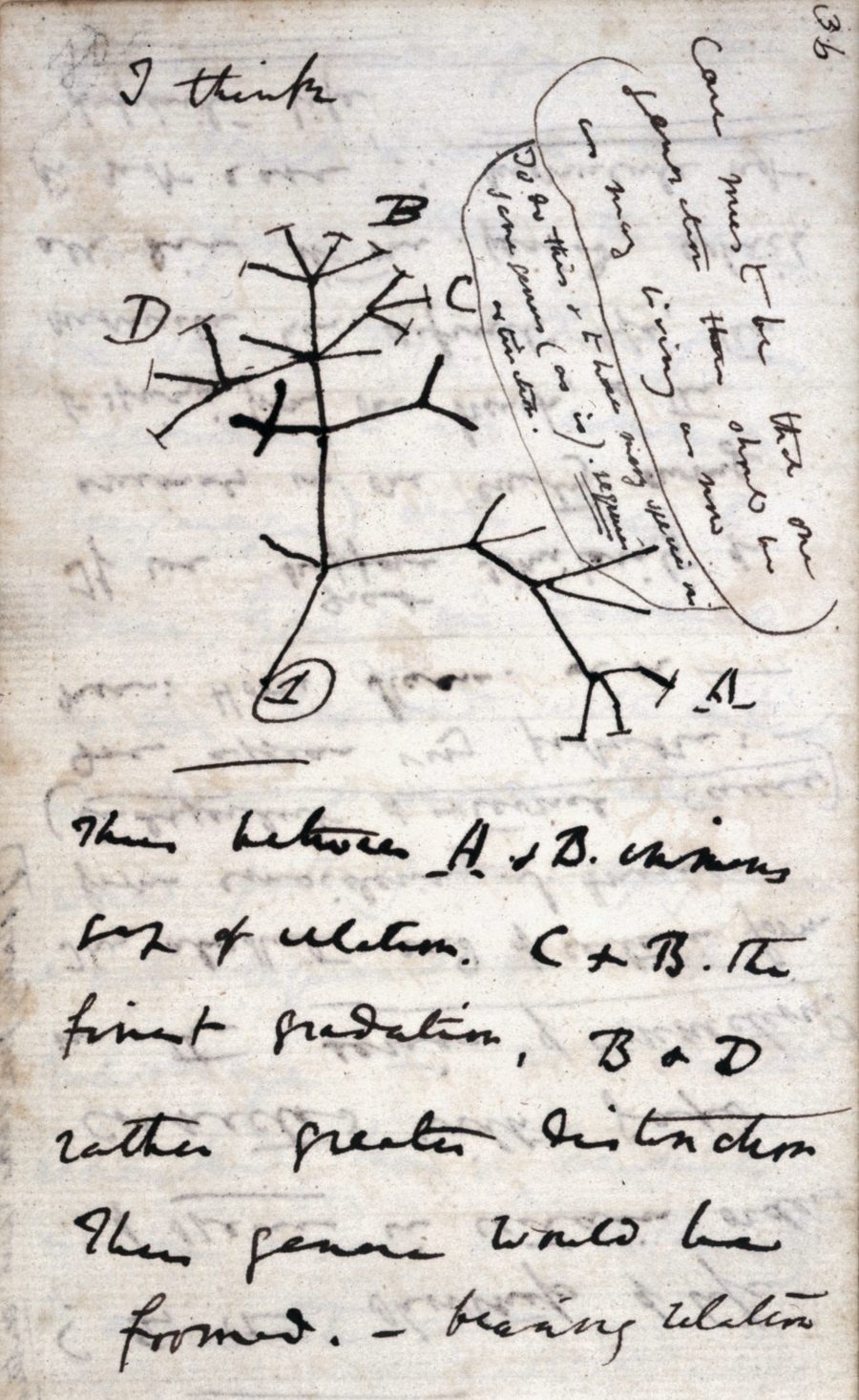
The UK was the home of Darwin. It can now become the home of one of the most impactful outcomes of his theory.

Using the evolutionary sciences to explain, treat and prevent mental health problems — starting with AI-powered tools that could reach millions, built by the field's most promising young talent and a fresh institution, here in the UK.

Page 36 of Charles Darwin's Notebook B, 1837: his first sketch of an evolutionary tree, annotated 'I think'.
"I think" — Darwin's first evolutionary tree.
Notebook B, 1837
Scroll
001 — The potential

A new paradigm for mental health, born on this island.

The UK is renowned for punching above its weight and changing the course of science and medicine. We intend to do it again.

In recent years, mental health diagnoses have rapidly expanded. Estimates of the size of the current burden in the UK vary with method, but all are huge: one major analysis puts the cost of mental ill-health to England at £300 billion a year — double the NHS budget; another approach estimates costs of 5% of UK GDP; official statistics count 22.1 million working days lost to work-related stress, depression and anxiety in a single year; disability claims for psychiatric conditions have doubled in six years; and the health-related welfare bill is forecast to pass £70 billion a year by the end of the decade.

Despite decades of effort and billions in funding, neuroscience and genetics have not delivered useful progress in understanding, treating or preventing mental disorder. The growing social problem is met by a complete lack of a promising scientific direction.

We believe the mental health sciences have been missing a core theoretical insight, one of this nation's great products: the evolutionary sciences.

Rather than simple diseases or "broken brains", most mental disorders are better understood as relating to evolutionarily adaptive human emotions and individual differences — traits that come with trade-offs, sometimes overshoot, or are misfitted to the modern world. Unlike evolutionary psychology, which is studied across the world and has decades of research, the field of 'evolutionary psychiatry', which focuses on mental disorder, is at a nascent stage. We believe it can transform how we understand, prevent and treat mental health problems — reducing disability and improving the world's happiness and productivity, starting with the UK.

The UK is already the global hub of clinicians and researchers in this field. The Evolution, Mental Health and Behaviour lab at the University of Cambridge, Evolutionary Psychiatry Special Interest Group of the Royal College of Psychiatrists and Foundation for Evolution and Mental Health hold the talent and the networks to develop an entirely new paradigm. We are connected with GPs and NHS clinicians keen to find new ways to reduce the mental healthcare burden.

What the field lacks is ignition funding, free of the shackles of slow-moving boards and university research bureaucracy. This is what the Foundation for Evolution and Mental Health was established to circumvent. A proof of concept project will help us attract further philanthropic capital to the UK — nowhere else has this density of expert talent, dedicated young institutions and networks of clinicians. We are set on scaling tools that lift the whole population's mental health: the productivity of UK workplaces, the vibrancy of UK classrooms, and the efficacy of UK mental health services — tools we can then export, making the UK the hub of a revolution in global mental healthcare by applying the fundamental theory of biology developed here 150 years ago.

AI has suddenly made it possible to take our small team's work to millions of people — in a matter of months — and our small island's work to billions — in not much longer.

002 — Who we are

A small team at the centre of a world-leading network.

Portrait of Adam Hunt

Adam Hunt

Postdoctoral researcher, Evolution, Mental Health & Behaviour lab, University of Cambridge · Founding Chair, FEMH

  • Built the field's infrastructure in a decade: revitalised existing institutions, established its first podcast and charity, and brought together a team in a Cambridge lab
  • Lead author of the first RCT of evolutionary explanations with UK clinicians — BJPsych, RCPsych "Article of the Month"
  • Four years of independent research in a Norfolk cottage became a funded PhD in Zurich — and a general-audience book, forthcoming 2027

Career

  • Executive committee, Evolutionary Psychiatry Special Interest Group, Royal College of Psychiatrists
  • Communications Chair, International Society for Evolution, Medicine & Public Health
  • Host of the Evolving Psychiatry podcast; revitalised EPSIG's YouTube channel and the WPA webinar series
  • Developed the DCIDE framework for testing evolutionary explanations — published for autism in Biological Reviews
  • Delivers evolution-informed training to NHS clinicians, including a full CAMHS training day in 2026

In this project: evolutionary psychiatry expert · knowledge base

Portrait of Kaia Tejani

Kaia Tejani

AI product developer · forward-deployed engineer, Yokahu · UCL Risk & Disaster Reduction

  • Winner of the UCL × Google hackathon — building an AI triage chatbot for NHS social prescribers, using a RAG-adapted LLM in under two hours
  • Has experience shipping this project's architecture: built, trained and deployed a production RAG LLM on AWS, turning complex risk data into plain-language guidance for insurance clients
  • Builds AI products end to end — developed and shipped the Swift Centre's risk-forecasting platform

Career

  • Research & policy intern at Pro Bono Economics — wellbeing valuation (WELLBYs) and impact evaluation of charitable interventions
  • First-class UCL dissertation on localised data in disaster-risk decision-making
  • Led a seven-person consultancy team; ran department-wide student-inclusion research at UCL
  • Selected for UCL's Venture Builder with her own grant-funded venture idea

In this project: tech lead · building the app

Portrait of Christian Cole

Christian Cole

Strategy Lead, FEMH · 17 years in investment research, fund management, business building and strategy

  • Launched a global equity fund from scratch at Dominion — it outperformed the S&P 500 and MSCI World, growing to ≈$300m under management
  • Helped build and scale Dominion's investment-platform business to ≈$700m under management — still acting as strategic adviser
  • Broad financial experience: Standard Chartered, three years at New York hedge fund Royal Capital, four at Sanford C. Bernstein, helping launch its European Industrials coverage

Career

  • Continued running the fund strategy for three further years at Pacific Asset Management after its acquisition
  • Guided a private company through a major restructuring programme — the business was acquired in 2025
  • BSc (Hons) Economics, University of London; completed all three levels of the CFA programme
  • Mentor with prisoner-rehabilitation charity Trailblazers in South London; three years a volunteer with Age UK

In this project: testing & rollout

The Foundation for Evolution and Mental Health

Established in December 2024 as a UK-registered charity, FEMH is the only organisation dedicated to funding research and education in evolutionary psychiatry. In 2025 we hosted our first event, a debate day in Cambridge. In 2026 we published our inaugural report laying out the case for how the evolutionary sciences can transform mental health science and treatment — accompanied by a University of Cambridge media statement to coincide with the publication of Hunt's RCT — followed by a prospectus of potential projects and a set of advisory board interviews. This will be our first fully developed and trialled tool, proving our ability to move fast in developing potentially far-reaching projects.

Our board and advisory board comprise the world's experts in the field. Our young talent are hyper-motivated and ready to grow FEMH into a leading, world-changing institution — optimised for speed, and built to circumvent existing research bureaucracy.

003 — The timeline of the field

How we got here.

The background to the field.

1950 — 2016 · The conceptual foundations

Lone voices, occasional ideas

Independent psychiatrists and researchers publish occasional papers and books on evolutionary theories of specific mental disorders. Conceptual foundations were developed but never translated into organisations, dedicated labs or empirical research programmes.

2016 — 2026 · The growth phase

The UK builds the institutions

0
EPSIG members
0
international conferences
0st
dedicated charity & RCT

Now · The inflection point

From groundwork to working tools

The theoretic groundwork has been laid. The UK networks are active and keen. Converting them into practical outcomes and tools is now the critical step for the field.

004 — This project

Prototype an AI tool for evolution-informed education and advice.

With a UK Dynamism grant, we will build the first version of an AI-powered tool that provides evolution-informed advice on improving wellbeing.

This prototype will act as a proof of concept and foundation tool that can be tested, built out further, and used to seek funding far more widely. In the future, the same tool can be adapted to extend to young people with mental health problems, parents of small children, and adults experiencing depression and anxiety — and rolled out in schools and offices to pre-empt and prevent problems.

Version one is a wellbeing companion for new mothers, focused on subclinical low mood. It comforts mothers that low mood when parenting solo is an expected human response, encourages them to seek social support, and connects them to local resources.

"It takes a village to raise a child." This proverb captures millions of years of our species' child raising

Why start with new mothers?

01 — The trial run

The prototype's real job is to pick low-hanging, well-defined fruit which can test how people engage with evolution-informed approaches — whether they find them useful, and how they use them in practice. After this pilot, we can expand the tool to other groups — young people, for example.

02 — The clearest case

Postnatal low mood is a huge, evocative problem with a well-established evolutionary cause: lack of social support. For millions of years parenting took a village; parenting alone is entirely unnatural. Simple psychoeducation on this insight has been trialled in our Cambridge group with great efficacy.

03 — The lowest-hanging fruit

Targeting subclinical low mood and all new parents keeps the tool a wellbeing product rather than requiring MHRA registration as a medical device. We can prove efficacy in a subclinical sample first.

04 — The expansion path

Once proven, the same approach and technology expands to other wellness problems — and, pending medical-device approval, to disorders such as postnatal depression. The blurred line between subclinical and clinical symptoms means we can test and iterate for wellness before converting to disorder with confidence of carried-over efficacy.

004 · A

How the tool works

Wellbeing companion
Illustrative conversation
Scripted example — not a live product

Layer 1A simple text & speech interface

A warm, plain conversation — by message or voice — designed for new mums and shaped by their feedback through the pilot.

Layer 2An open-source LLM

A capable open-source model provides the engine — we build it to be inspectable and adaptable.

Layer 3An evolution-informed knowledge base

The model is adapted with a specific prompt and a curated, expert-built knowledge base.

The result: advice that reframes low mood as a meaningful signal, nudges mothers towards social support, and points to local resources.

004 · B

Six months, two phases

Phase one · month 1
Build
The first tool, built internally, with its knowledge base
First working version, in internal testing
Phase two · months 2–6
Pilot, iterate, polish
Slow rollout with real users; feedback loops; refinement towards a deployable product
Polished tool — ready for randomised testing or MHRA submission
First working version, in internal testing
Polished tool — ready for randomised testing or MHRA submission
004 · C

What exists at the end

The tool

A polished, working, evolution-informed AI companion for new mothers

Piloted, iterated, and carrying positive initial feedback — ready for randomised testing and rollout under experimental conditions, or submission for approval as a medical device.

The proof of concept

Evidence that the UK is the place to build what comes next

A working, tested tool which establishes the Foundation for Evolution and Mental Health as a fast-moving, high-impact institution through which a whole field can be built out. Proof for funders and partners that evolution-informed AI works, and the start of a whole set of revolutionary, AI-powered, evolution-informed tools for mental health.

004 · D — Six months · three people · overheads and running costs

The ask: £50,000

£45k — the team
£5k
£45k the team — six months of build, knowledge base, testing and rollout
£5k costs and overheads
005 — The future

How this becomes a world-changing paradigm.

Mental disorders touch everyone, from the poorest to the wealthiest — and progress has been stalled for decades. The philanthropic potential is enormous.

$3.7bn/yr

spent globally on mental health research, every year — into a paradigm that, by a former US National Institute of Mental Health director's own admission, has produced no validated biomarkers and little in the way of novel treatments since 1980

≈ $0

of it goes to evolution-informed research. Low hanging fruit is waiting to be picked.

This prototype will justify funding the field: evidence for philanthropists that evolution-informed tools show promise, and that the UK — through the Foundation for Evolution and Mental Health, the University of Cambridge, and the Royal College of Psychiatrists' networks of clinicians and researchers — is the place to build them.

  • Months 0–6

    Build and pilot the prototype. An evolution-informed AI companion for new mothers, iterated through an initial feedback-development cycle.

  • Years 1–3

    Expand and measure. Versions for teens, workplaces, and general depression and anxiety. RCTs measuring impacts on wellbeing and productivity. Significantly more funding attracted to the UK field.

  • Beyond

    National and international rollouts and a shifted paradigm. Deployment via GPs, schools and offices; a field that changes the narratives and treatments of mental health around the world. Born out of the country of Darwin.

The UK has a unique opportunity in its world-beating talent and institutional readiness. We just need to get going.